Smart Planter vs Self-Watering Pot: What’s the Difference?
Compare smart planters and self-watering pots by watering method, sensors, control, maintenance, travel readiness and the plants they suit best.
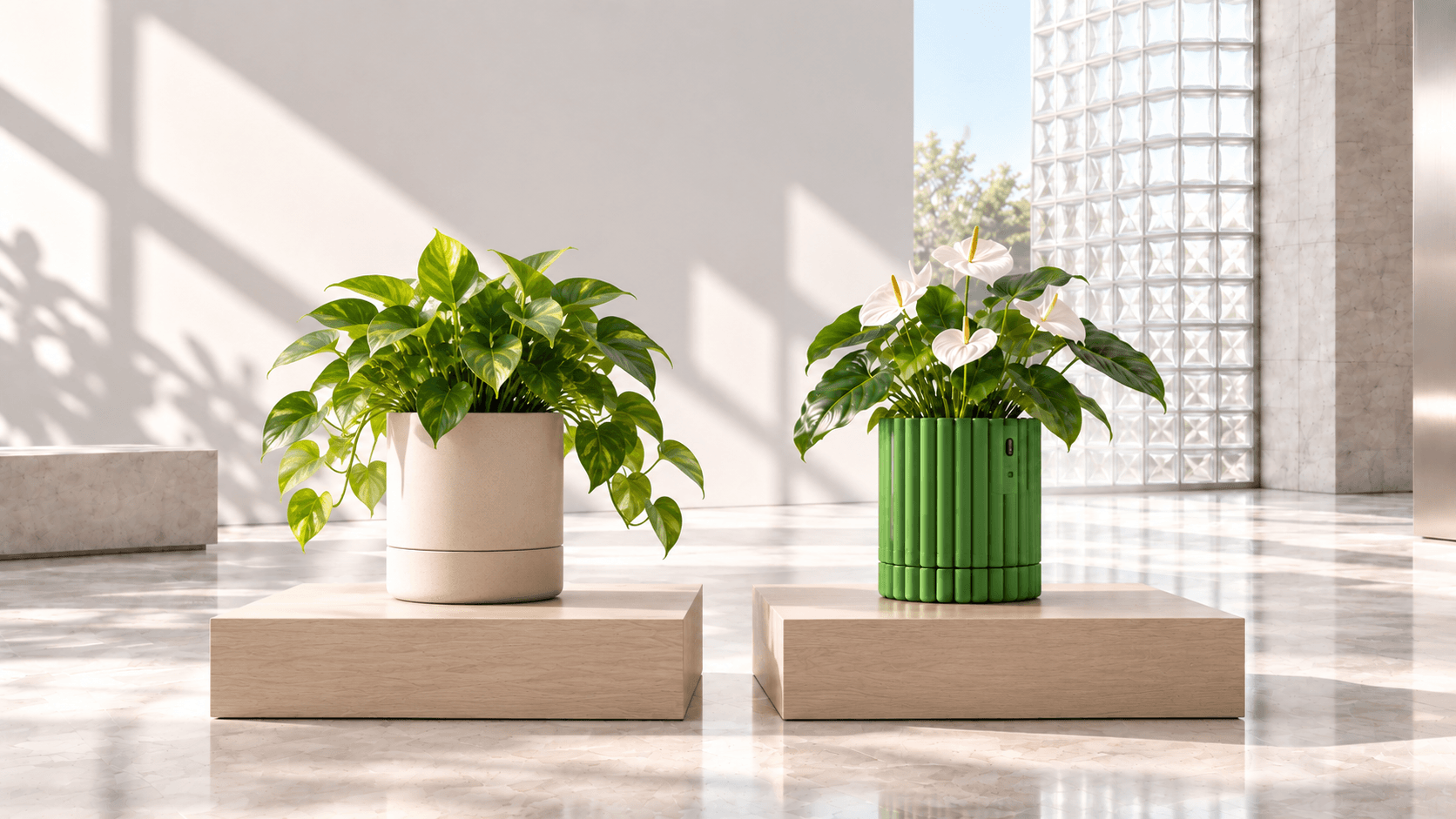
The difference between a smart planter and a self-watering pot is feedback. A traditional self-watering pot stores water and makes it available to the soil, usually through a wick or capillary column. A smart planter measures conditions, interprets those readings and may release a controlled amount of water only when the plant needs it.
Both can reduce day-to-day watering effort. They are not interchangeable, however. One is primarily a passive container; the other is a sensing and decision system. The better choice depends on your plant, your routine and how much visibility you want.
Quick comparison
| Feature | Self-watering pot | Smart planter | | --- | --- | --- | | Main mechanism | Reservoir plus wick or capillary action | Sensors, software and often a pump | | Decision to water | Water remains available passively | Triggered by measured conditions and rules | | Plant-specific behavior | Usually determined by wick, soil and reservoir design | Can use a selected plant profile | | App or alerts | Usually none | Often includes status, history and notifications | | Power or connectivity | Usually not required | May require power, Wi-Fi or Bluetooth | | Best strength | Simplicity | Feedback and control | | Main risk | Mix stays wetter than the plant prefers | Poor settings, sensor contact or neglected maintenance | | Typical cost | Lower | Higher |
The table describes common designs, not every product. Some “smart” pots only monitor and do not water. Some premium self-watering pots include a level gauge. Always check the actual mechanism.
How a self-watering pot works
A self-watering pot usually has two zones: soil above and stored water below. A wick, absorbent insert or section of potting mix bridges the gap. As the upper mix loses moisture, capillary action pulls water upward.
The system is elegant because it uses no electronics. Fill the reservoir and the physical properties of the wick and mix do the work. This can keep moisture relatively even and extend the time between refills.
The pot does not know which species is growing in it. It cannot distinguish a fern from a succulent, recognize that a room has become cooler or decide to pause because the root zone has stayed wet too long. Performance depends on matching the plant with the container, soil and wick.
How a smart planter works
A smart planter adds a loop of measurement and response. A moisture sensor checks the root zone. Software compares the reading with a target range. If the system includes active watering, a pump transfers a measured dose from the reservoir when defined conditions are met. The app can show the reading, last watering, next check and alerts.
Some products also track light, temperature or humidity. These signals can explain why water use changed, though they do not replace correct placement and potting mix.
Chlora One is designed as an active smart planter. Its selected plant profile sets moisture and watering rules. The pot checks the soil on a schedule and runs the pump only when the soil is dry enough. The app brings care status, moisture, light, watering history, notifications and guidance together in one place.
Which gives better control
A smart planter offers more explicit control because the watering decision can be tied to a measurement and a plant profile. You can review what happened rather than infer it from the reservoir level.
A passive self-watering pot offers a different kind of control: mechanical simplicity. There is no software update, connectivity issue or sensor calibration to consider. You influence performance through reservoir level, wick material, potting mix and how long the system remains connected.
Neither approach is automatically superior. The useful form of control is the one you will understand and maintain.
Which is safer for overwatering
The answer depends on the design and plant. A sensor-led system can wait until moisture crosses a lower threshold, then deliver a known amount. That is a strong defense against watering by habit.
But sensors are not magic. A badly placed probe may read a dry pocket while another part of the root ball remains wet. Dense soil may hold water too long. Repeated manual watering can override sensible automation.
A passive reservoir avoids pump errors, but it keeps water continuously available. If the wick is too strong or the plant needs a pronounced dry period, the mix may remain wetter than ideal.
For either type, good drainage and appropriate soil structure matter. University extension resources repeatedly note that wet, poorly drained conditions can contribute to root problems. A planter cannot make unsuitable soil disappear.
Which is better while you travel
For a short trip, either system may work once it has been tested. A passive pot can be dependable because it has few points of failure. A smart planter adds remote visibility and alerts, which can be reassuring if you want to confirm moisture, reservoir or connectivity status.
For longer trips, reservoir capacity becomes decisive. A connected app cannot create water after the tank is empty. Test real consumption during a normal week and arrange a trusted person for longer absences or unusually demanding plants.
The smart planter has an advantage when conditions change unexpectedly: it can delay watering during a cool, slow-drying week or act sooner during a warmer one. A timer cannot adapt in the same way, and a wick does not report what it is doing.
Which plants suit a self-watering pot
Passive self-watering containers often suit plants that prefer consistent moisture and tolerate continuous access to a reservoir. Examples can include peace lilies, fittonias, many ferns, some calatheas and thirsty tropical foliage plants—provided the soil remains aerated and the specific plant’s needs are respected.
They can be less forgiving for cacti, succulents, snake plants, ZZ plants and herbs such as rosemary that prefer a stronger dry-down and free-draining conditions. This is not an absolute prohibition; wick strength and mix can be adjusted. It does mean the margin for error is smaller.
Which plants benefit from a smart planter
A smart planter is useful when the preferred moisture cycle is specific, when the room changes through the seasons or when you want a record. Plant profiles can set different ranges for different species, and controlled water delivery can preserve a dry interval instead of keeping the mix continuously connected to water.
It is also helpful for people caring for multiple plants. Instead of remembering a separate calendar for every pot, you can review conditions and alerts. Chlora’s care system is being developed around more than 500 plant profiles, allowing watering behavior to be connected to the plant rather than a universal schedule.
Dry-loving species still need caution. Smart automation may be capable of waiting longer, but the system must be configured correctly, and the potting medium must drain freely.
Maintenance and ownership
Self-watering pot maintenance
Passive systems need cleaning too. Mineral deposits can build in reservoirs and wicks. Roots may grow into the water chamber. Algae or odor can develop if water stands for long periods. The level gauge, if present, may need cleaning.
Maintenance is usually visible and mechanical: empty, rinse, inspect and replace a wick when necessary.
Smart planter maintenance
A smart planter adds the pump, sensor and software. The reservoir and water path need cleaning according to the manufacturer’s instructions. The app and firmware may need updates. The owner should watch for offline status, unexpected readings and low-water alerts.
This is not necessarily burdensome, but it is a different ownership model. You are maintaining a small appliance as well as a planter.
Design and everyday experience
Many self-watering pots are designed around function first. Others are beautiful pieces of ceramic or molded plastic. Smart planters sometimes reveal their technology through screens, cables and bright indicators; others try to hide it.
Chlora takes the quieter approach. The vertically fluted planter contains the sensing, reservoir and watering system, while the app holds the detailed interface. The object is intended to live comfortably in a Scandinavian-inspired interior rather than look like equipment on a shelf.
That design choice has practical value. A planter stays in view every day. Material, scale, cleaning, pump noise and the visibility of cables can matter as much as an extra chart.
Cost and value
A self-watering pot is usually less expensive because it has fewer components. It can be excellent value when you need simple moisture buffering and are comfortable learning the right wick-and-soil balance.
A smart planter carries a higher initial cost because it includes sensors, electronics, a pump, software and ongoing product support. The value comes from plant-specific automation, remote visibility, history and alerts—not from the reservoir alone.
When comparing price, include the full setup. Does the product require a subscription? Are replacement probes or proprietary liners needed? What happens if the app service ends? Can you clean and repot it without specialist parts? Clear answers are worth more than a long feature list.
Choose a self-watering pot if
- You want a simple, quiet system with no app.
- Your plant appreciates consistent access to moisture.
- You are willing to tune the wick and potting mix.
- You prefer a lower upfront cost.
- You do not need remote status or watering history.
Choose a smart planter if
- You want watering decisions based on measured soil conditions.
- You care for plants with different moisture preferences.
- Your schedule or indoor conditions change frequently.
- Alerts and history would reduce uncertainty.
- You travel and value remote visibility.
- You want controlled water delivery rather than continuous wicking.
The middle ground
You can also pair a conventional pot with a standalone sensor, or use a passive self-watering pot plus a moisture meter. That can add information without buying a fully integrated system. The compromise is fragmentation: you still interpret the reading and water manually, and the sensor may not be designed around the pot’s geometry.
An integrated smart planter is most compelling when sensing, plant rules and water delivery operate as one system.
The verdict
If your priority is simplicity, a well-matched self-watering pot can be an elegant solution. If your priority is feedback, plant-specific behavior and controlled automatic watering, a smart planter is the stronger fit.
Do not choose based on the label. Ask four concrete questions: What does it measure? Who decides when to water? How is water delivered? What happens when something goes wrong?
Chlora One is being built for owners who want the answer to be clear: the pot senses the root zone, applies the selected plant profile, waters from its integrated reservoir when conditions call for it and explains the result in the app. Chlora is building toward Kickstarter; join the launch list for product updates.
Frequently asked questions
Is a smart planter the same as a self-watering pot
No. Both may contain a reservoir, but a smart planter adds sensors and software. A self-watering pot usually supplies water passively without measuring the root zone or applying plant-specific rules.
Does a self-watering pot need electricity
Most passive self-watering pots do not. Smart planters with pumps and connected features require a power source, rechargeable battery or another electrical arrangement depending on the design.
Can I put succulents in a self-watering pot
It is possible, but many succulents need modest watering, abundant light and a fast-draining mix. A continuously wet wick system can be a poor match. Use a setup specifically tuned for a long dry-down and monitor it closely.
Are smart planters good for beginners
They can be, especially when the app explains status in plain language. Beginners still need to choose the correct plant profile, use suitable soil and respond to maintenance alerts.
Which option lasts longer without a refill
Duration depends on reservoir size and plant water use, not the label. A smart system may conserve water by waiting for a threshold, while a passive wick may be extremely efficient for a compatible plant. Test the actual setup.
Sources and further reading
- University of Minnesota Extension, Spring houseplant care: https://extension.umn.edu/garden-and-home/yard-and-garden/gardening-in-minnesota/houseplants/spring-houseplant-care
- University of Minnesota Extension, Cacti and succulents: https://extension.umn.edu/garden-and-home/yard-and-garden/gardening-in-minnesota/cacti-and-succulents
- Royal Horticultural Society, How to water containers: https://www.rhs.org.uk/container-gardening/how-to-water-containers
- Chlora One user manual and product source material